
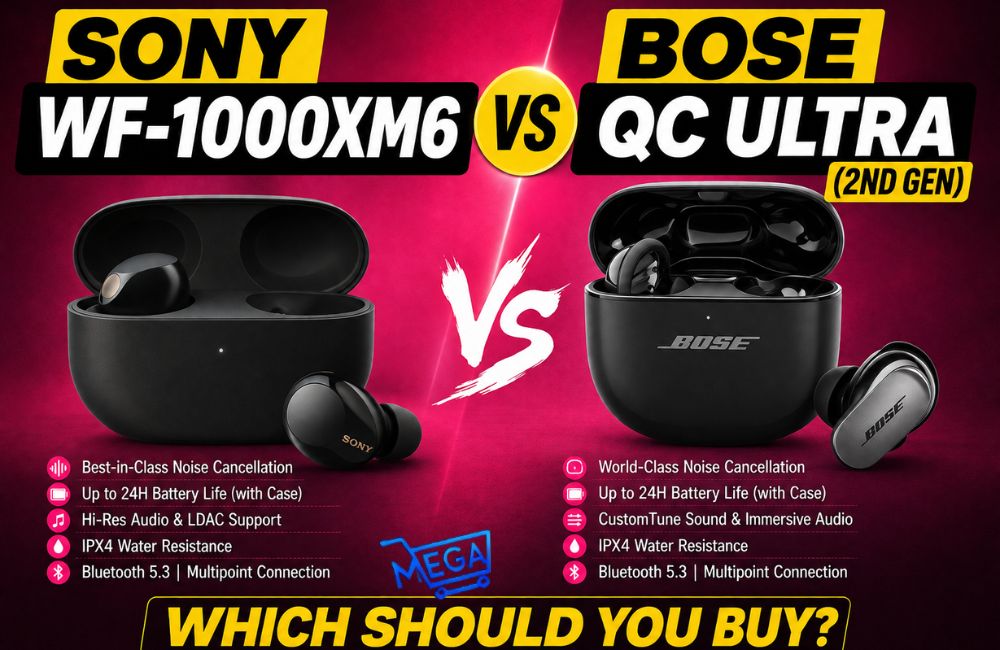
If you are choosing between the Sony WF-1000XM6 VS Bose QC Ultra Earbuds, the decision comes down to a few core priorities: noise cancellation, comfort, battery life, call performance, and future-ready connectivity.
Both sit in the premium true wireless category, and both aim at buyers who want top-tier active noise cancellation. But they do not offer the same strengths. Sony pushes a lighter design, longer battery life, and support for newer Bluetooth features. Bose leans on its reputation for exceptional ANC and strong long-wear comfort.
Here is a clear breakdown of how they compare and which model makes more sense for different user types.
Quick Answer
Buy the Sony WF-1000XM6 if you want better battery life, lighter earbuds, and support for Bluetooth LE Audio. Buy the Bose QC Ultra Earbuds if your top priority is the strongest possible noise cancellation and a very comfortable fit for extended listening.
What Makes this Comparison Important?

See Also: Best Wireless Earbuds in 2026
This is a battle between two of the biggest names in premium noise-cancelling audio. Both products are aimed at buyers who expect more than basic wireless earbuds.
- Sony WF-1000XM6 is positioned as the next step after the well-regarded WF-1000XM5.
- Bose QC Ultra Earbuds continue Bose’s long-standing focus on active noise control and in-ear comfort.
Noise Cancellation: Which one is Better?
Sony WF-1000XM6 ANC
Sony makes major claims here. The WF-1000XM6 uses the HD Noise Cancelling Processor QN3e, the Integrated Processor V2, and an adaptive noise-cancelling optimizer. Sony also claims a 25% improvement over the previous generation and describes the earbuds as offering the world’s best noise-cancelling performance.
That is an ambitious promise in a product category where gains are usually modest from one generation to the next.
Bose QC Ultra ANC
Bose has an extremely strong reputation in this area, and the QC Ultra Earbuds are already widely recognized as among the best noise-cancelling earbuds available. Their ANC is powerful enough to compete with, and in some situations outperform, over-ear headphones. Bose stands out especially in reducing:
- Low-frequency rumble
- Office chatter
- Urban background noise
Verdict on ANC
Bose is the safer choice if your main goal is maximum noise cancellation right now. Sony’s claims are impressive, but Bose already has a proven edge in this space based on the available comparison details.
If Sony’s real-world improvement matches its promises, the WF-1000XM6 could challenge or surpass Bose. But based strictly on the supported information, Bose remains the benchmark for ANC performance.
Comfort and Fit
Comfort matters more than many spec sheets suggest. Even the best-sounding earbuds become frustrating if they feel heavy, unstable, or tiring after an hour or two.
Sony WF-1000XM6 comfort
Sony redesigned the WF-1000XM6 with a new shape intended to improve both stability and long-term wearability. Each earbud weighs 6.5 grams, which makes it noticeably lighter than the Bose model.
Bose QC Ultra comfort
The Bose QC Ultra weighs 7.7 grams per earbud. Even though it is heavier, it has been praised as one of Bose’s most comfortable in-ear designs, with a fit that feels secure without becoming harsh during longer sessions.
Verdict on Comfort
- Choose Sony if you want the lighter earbud and value a redesigned fit aimed at stability.
- Choose Bose if you care most about established long-session comfort and a gentle in-ear feel.
Battery life: Sony has the Clearer Advantage
Sony WF-1000XM6 battery life
Sony rates the WF-1000XM6 at up to 8 hours on a single charge, with an additional 16 hours from the charging case.
That is not class-leading by a huge margin, but it is strong and competitive for premium noise-cancelling earbuds.
Bose QC Ultra battery life
Bose rates the QC Ultra at 6 hours of playback, but real-world use is noted as being closer to 5 hours.
For a premium product, that is a weaker result and falls behind many competitors.
Verdict on Battery
Sony wins battery life clearly. If you dislike frequent charging or often use earbuds for long workdays, travel, or back-to-back calls, the WF-1000XM6 offers the more practical setup.
Call Quality and Microphone Performance
Call quality can be a deciding factor for people who use earbuds at work, outside, or while commuting.
Sony WF-1000XM6 call quality
Sony says the WF-1000XM6 delivers its best call quality yet. It uses AI beamforming noise reduction to focus on the user’s voice while reducing surrounding noise.
This matters because the previous WF-1000XM5 was considered generally solid for calls, but not always perfectly consistent. The expectation here is improved voice isolation and more reliable performance in noisy environments.
Bose QC Ultra call quality
Bose has also improved meaningfully in this area. The QC Ultra is described as doing a better job than earlier Bose models at picking up speech clearly while minimizing distractions like nearby conversation and ambient street noise.
Verdict on Calls
Both brands are aiming higher here, but the available information suggests both are competitive rather than one being a runaway winner.
If you want the newer voice-processing approach, Sony may be more appealing. If you prefer a model that offers better background isolation than its predecessor, Bose remains a strong option.
Connectivity and Future-proofing
Sony WF-1000XM6 connectivity
The WF-1000XM6 supports Bluetooth LE Audio, a newer low-latency standard that can help with:
- Gaming
- Video lip-sync
- Longer-term compatibility with emerging Bluetooth features
That does not automatically make the earbuds a gaming-first product, but it does improve future readiness and broadens the use case beyond music and podcasts.
Bose QC Ultra connectivity
Verdict on connectivity
Sony wins for future-proofing. If you care about newer wireless standards and lower-latency potential, the WF-1000XM6 is the more forward-looking choice.
Side-by-side Comparison
- Noise cancellation: Bose QC Ultra has the more established edge
- Weight: Sony WF-1000XM6 is lighter at 6.5 g vs 7.7 g
- Comfort: Both are strong, Bose has a particularly comfortable reputation
- Battery life: Sony leads with up to 8 hours plus 16 from the case
- Call quality: Both show meaningful improvements and are competitive
- Connectivity: Sony leads with Bluetooth LE Audio support
- Value: Sony looks stronger if battery and features matter most
Who Should Buy the Sony WF-1000XM6?
The Sony WF-1000XM6 makes the most sense for buyers who want a more rounded feature set. Choose Sony if you want:
- Longer battery life
- A lighter earbud
- Bluetooth LE Audio support
- A redesigned fit focused on stability
- Strong ANC with ambitious next-generation hardware
This option is especially appealing for people who use earbuds throughout the day and do not want battery life to become a weak point.
Who Should Buy the Bose QC Ultra Earbuds?
The Bose QC Ultra is the better fit for buyers who care most about blocking out the world. Choose Bose if you want:
- Top-tier active noise cancellation
- Excellent reduction of low-frequency and environmental noise
- A highly comfortable fit for long sessions
- A premium in-ear experience centered on isolation and refinement
If your main use cases involve commuting, office work, flights, or noisy public spaces, Bose has the more proven ANC advantage.
Common Buying Mistakes to Avoid
Assuming the best ANC means the best overall earbud
Noise cancellation matters, but it is not everything. Battery life, comfort, and call quality may affect your daily experience more than a small difference in ANC.
Ignoring battery life
The Bose QC Ultra’s shorter real-world endurance could become frustrating if you wear earbuds for long stretches. This matters more than many buyers expect.
Overlooking fit preferences
Even though Sony is lighter, some users may still prefer the feel of the Bose design. Weight alone does not decide comfort.
Buying for future features you may not use
Bluetooth LE Audio is a real advantage for Sony, but it matters most if your devices and habits benefit from it. If your only priority is blocking noise, Bose may still be the better match.
Which is Better for Commuting?
Bose QC Ultra is the stronger pick if your commute is noisy and your goal is the most effective isolation from trains, buses, traffic, and surrounding conversation.
Sony WF-1000XM6 becomes more attractive if you also care about battery life during long travel days.
Which is Better for Work Calls?
Both appear improved for voice pickup and background suppression. Sony emphasizes AI beamforming, while Bose is noted for clearer speech capture and reduced interference compared with earlier models.
If calls are a major priority, both are worth considering, but the available details do not support a decisive overall winner between them.
Which is better for long listening sessions?
This depends on whether you value comfort or endurance more.
- For comfort: Bose has a particularly strong reputation
- For battery life: Sony is clearly ahead
If you regularly listen for many hours at a time, Sony’s extra runtime may be the more meaningful advantage.
Conclusion
The Sony WF-1000XM6 is the better all-around buy for most people. It offers longer battery life, a lighter build, and better future-proofing through Bluetooth LE Audio, while still aiming for flagship-level ANC and improved call quality.
The Bose QC Ultra Earbuds remain the better choice for buyers who want the most proven noise cancellation. Their ability to suppress rumble, chatter, and city noise is the standout strength in this comparison.
If your buying decision starts with ANC and ends there, go with Bose QC Ultra.
If you want a more balanced package with stronger day-to-day practicality, go with Sony WF-1000XM6.